

Ted Lasso Season 4 - Rebecca's Character Arc: A Journey of Significant Transformation

Updated: Sep 12
Contains SPOILERS
This one is for my fellow Season 4 Ted Lasso fans; for the Ted-heads who enjoy taking deep dives into the characters, themes, and storylines…
As of this writing, we are halfway into the fourth season, which centers around a new story — the newly founded women’s team of AFC Richmond and the unique challenges of building a professional women’s athletic team from the ground up.
Rebecca Welton (Hannah Waddingham), owner of the AFC Richmond Football Club, assumes the mantle of this monumental goal in partnership with Keeley Jones (Juno Temple), Chief Marketing Officer of the women’s team and one of Rebecca’s “besties,” with the support of Leslie Higgins (Jeremy Swift), Director of Football Operations, who also serves as both grounded truth-teller and comedic levity for the audience at just the right moments.

These three main characters along with the titular character, Ted Lasso (Jason Sudeikis), were the grounding forces that kept us anchored into the TL world in previous seasons.
Episode 1: Home
This season opens with our four main characters re-establishing the world for us, but for a moment, it doesn’t feel quite right…We’re not in Richmond anymore, we’re in Ted’s beloved Kansas, catching up on where our characters are now.
It’s a bit disorienting to so quickly learn that Ted isn’t even coaching his son’s soccer team, let alone as a profession anymore. And we may not yet know why, but Rebecca seems a bit off too, but by the end of episode four, Rebecca’s arc for this season comes into much sharper focus for me, and its theme is “Wicked for good.”

Costume Storytelling
The costumes characters wear are meaningful and provide visual depth to the story, as do the props on set, whether used by the actors or not. Repeated references to The Wizard of Oz were used in the previous three seasons of Ted Lasso, particularly Season 3 as Ted grapples with the idea of leaving Richmond to return home.
As our three main characters from Richmond step into Ted’s Kansas, we are once again provided such visual representations. Keeley is dressed up in her own version of Dorothy, complete with glittery red shoes, while Rebecca’s soft pink dress is giving Glinda the Good Witch vibes. However, by the time Rebecca has completed eating two separate rounds of barbecue, I'm beginning to pick up more Wicked! vibes than The Wizard of Oz…
Color as Language
During their catch-up lunch, Rebecca mentions she recently changed her favorite color to green. This seemingly trivial line did get me to notice that she soon changed out of her pink Glinda dress into a rich emerald one giving Elphaba vibes.
Elphaba is a character that represents being “the ultimate outsider” because of her green skin. She also symbolizes societal prejudice, the rejection of conformity, and the danger of corrupted power structures. These themes definitely run throughout the season as Rebecca and Keeley launch the first AFC Richmond Women’s team. And the Wicked! vibes grow stronger…
Yes, green is the color of envy, and Ted makes a quip on it as soon as Rebecca mentions it: “I envy your ability to change.” (And change she will this season!)
Green also often signals health and harmony, representing spring, new life, growth, nature, and the heart chakra. Meanwhile, the pink of her Glinda dress often represents compassion and kindness, playfulness and intuition. And the dark blue that Rebecca wears the next day is often associated with knowledge, power, integrity, and professionalism.
Symbolism & Subtext
Rebecca's enthusiasm for Kansas barbecue leads to not only a running gag throughout the episode, but also driving the need for noticeable wardrobe changes. While some viewers reached for tropes like ‘Rebecca must be pregnant,’ to explain her messy and insatiable eating habits, my mind just kept returning to how a character’s wardrobe also tells a story.
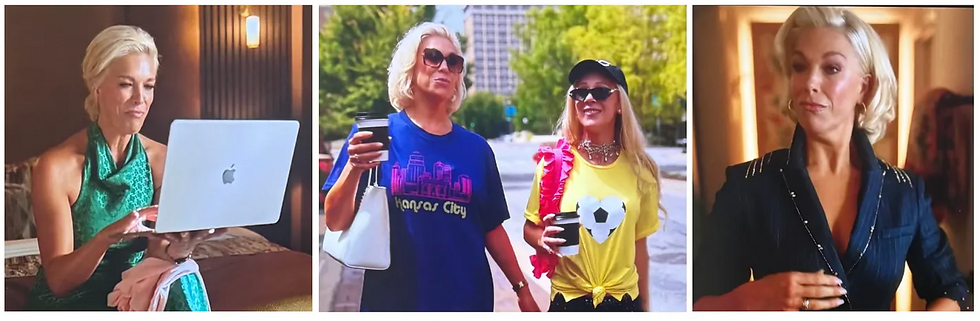
Her ever-changing wardrobe could represent her ‘wearing many hats’ like taking on new roles, patterns, perspectives, or projects this season. Our clothing is a way of expressing ourselves, so maybe she’ll spend some of the season playing around with expressing herself differently or working on some inner aspect of herself.
As for Rebecca not being able to get enough barbecue, that could be for any number of reasons, including a demonstration of Rebecca’s ‘hunger’ (power/drive) to go after what she wants.
After watching this episode, while I wasn't quite sure what was going on with Rebecca, I felt confident that her wardrobe here was visually communicating parts of her story to us: from the “Glinda and Elphaba” dresses and a touristy Kansas t-shirt to the Dazzle Me Moi power pantsuit complete with a bedazzled rising phoenix on her back!
Immediate recognition of the symbolism of the phoenix spurred my imaginative, intuitive brain to collaborate with the logical, reasoning part of my brain in fitting together these little pieces in ways that made the best sense for what I know about Rebecca. Before my thoughts even fully formed, I understood that this season, Rebecca will be experiencing significant transformation!
I envy your ability to change…
Costuming as a Reflection of Transformation
As a transpersonal psychologist and educator, my deepest passion and life’s work is dedicated to supporting others through transformation. I’m no stranger to the symbols of transformation. The rising phoenix on Rebecca’s bedazzled power suit, as well as the butterflies painted on Tammy’s storefront, are both symbols of transformation, signaling the cycle of life, death, and rebirth that is constantly happening in nature and all around us. They are visual reminders that when we allow ourselves the necessary time and space to stretch and change and grow, this natural cycle also occurs within us…
I BELIEVE that when Rebecca and Keeley enter Dazzle Me Moi, we are aren’t just watching two friends go shopping. We’re also witnessing Rebecca enter the portal into her next significant journey of transformation…

At first, the name of Tammy’s store confused me; I never studied French, but know moi means me/myself, making the name translate to “dazzle me, myself.” This seemed unnecessarily redundant. But on second thought…the name Tammy gave her store is so much deeper than I originally believed! Yes, she sells bedazzled clothing and yes, dazzle refers to bright light. And…Dazzle also means “to lose clear vision, especially from looking at a bright light” or to “overpower with light.”
After watching the second episode (discussed later) I gained more clarity of this scene and Rebecca's arc, but will delve into it here before moving on to the details of Episode 2.
Starting right there in Kansas with Tammy Dineen of Dazzle Me Moi, (and then again and again with other women in each episode that’s followed) we witness Rebecca making a bit of space for her own transformation to begin…
Throughout the first several episodes, we see evidence of Rebecca’s transformation in quick flashes of exchanges she has with other women; exchanges that shine a light upon what had been hidden from Rebecca’s view, covered in the darkness of unawareness, until that very moment.
We’re shown the beginning stages of Rebecca’s new transformational journey, even if perhaps more subtly than with previous character arc from seasons 1-3. But when attuned to it, it's visible not just in watching the actors, but noticing certain aspects of the costumes and props, music and sound, and the blocking and lighting.
I see this new storyline of the series highlighting Rebecca’s journey of losing the some of the “clear vision” she once had of certain aspects of her life in order to explore, examine, and ultimately expand her vision to encompass so much more than it held before this trip to Kansas…and I BELIEVE that by the end of this transformative journey, Rebecca will indeed dazzle herself with her own bright light…

Dazzle Me Moi: Tammy Dineen
Rebecca is changing into her phoenix rising power suit in the dressing room, while Keeley remains just outside of it excitedly talking about big ticket purchases for the women’s team. There's tension is Rebecca’s face as she calls out to Keeley, saying there’s something she needs to tell her, only to be interrupted by Tammy checking in on her.
As Rebecca emerges to show them her outfit, Keeley and Tammy hype her up, with Tammy calling out “Whooo-weee! Well consider moi dazzled!” (Her catchphrase perhaps when a customer has hit upon just the right look for herself?)

The women get to talking and Tammy shares how she used the money from her divorce settlement to open up her store, but hit hard times until Taylor Swift came to town on tour. One of her backup singers bought an outfit from Tammy, then posted it on her instagram, boosting Tammy’s sales and business has been doing well since then. Tammy wraps up her story with a quote that literally takes Rebecca’s breath away, “Women helping women, am I right?” Seeing the expression on Rebecca’s at hearing this speaks volumes.
And for the first time, I reflect on how Rebecca felt walking into that Akufo meeting a few years back and what meetings with “power players” in the industry must feel like for Rebecca right now as she embarks on this endeavor with the women’s team…
Tammy put a spotlight on the idea of women helping women. It’s a quick and relatively small exchange, but I feel the weight of its significance.

It's as if a seed has been planted in Rebecca’s psyche that she will carry with her back to AFC Richmond. Perhaps right now, she's only focused on what "women helping women" means in terms of her relationship with Keeley. But Tammy’s words made such an impact on Rebecca that in the next episode, we witness that seed take root in a very different way...
Episode 2: Curiouser and Curiouser!
We’re back in Richmond. From the episode title and playing around with the size of objects (and locker rooms) to the introduction of a new character named Alice, (Tanya Reynolds) Episode 2 frequently alludes to Alice in Wonderland. It's an appropriate analogy to the journey Rebecca takes in this episode...
The cold open in Rebecca’s office gets quite chilly when she and Higgins are joined by Alice Chilton, Assistant Manager of the women’s team. Higgins invites her in after delivering copies of his very thick report on the analysis of the viability of an AFC Richmond women’s team.
Finding the Light: Alice Chilton
A guide or technical blueprint for lighting design on a set is called a light plot. It lays out what kind of lighting will be used, where and how it will be set up, and how it will be used to get certain kinds of light on specific subjects at certain angles. And in this scene that first introduces us to Alice, the use of light provides rich context for Rebecca’s inner journey.
Alice has come to see Rebecca for the purpose of resigning. Rebecca politely accepts, but is obviously not disappointed by this at all, which clearly disappoints Alice. Most of this exchange is shot using singles, where the camera captures only one actor in frame at a time, allowing viewers to focus entirely on that character.
When Alice is in frame, I’m focused mainly on her eyes to track her emotions. When Rebecca's in frame, I notice the tension in her face and body, especially her neck.

I also notice how their faces are only partially lit; the right side of Alice’s face is in shadow, while the right side of Rebecca’s face is lit. And when we get to the quick exchange that allows Tammy’s seed to take root, I notice how the angle of each visual shot allows for particular placement of the lamps in Rebecca’s office. Rebecca’s singles are framed with a lit lamp behind her, until Alice gets up to leave…
She pauses on her way to the door, then resolutely walks back to Rebecca to ask, "did you ever consider me for head coach?”

Rebecca takes a moment and politely but directly replies, “No.” Of course not, she really only considered Ted and he accepted. Alice accepts this response, and seems to respect it. Then she gets curious, “Hmm….Did you consider any woman?”
With this one question, Alice shines a light onto something that Rebecca had never before noticed. It gives Rebecca pause. And in that frame, we see Rebecca at an angle that shows the light next to her, not behind her anymore. After consideration, Rebecca speaks her truth, “No.”
In the silence that follows, it’s clear that neither woman likes what she’s sees in this light. And now that Rebecca has seen it, she can’t unsee it…

She then spends the rest of the episode dealing with the aftermath of this moment. First, she’s in a state of incredulousness, flailing about, all upset that Alice has “accused” her of not being a feminist. (Even as Higgins points out that's not what Alice said at all.)
We have all participated in this kind of psychological projection, usually without realizing it. And when we become aware that we’re using projection and can acknowledge the truth we’d rather deny about ourselves, that’s an integral step towards accepting and taking personal accountability for that truth by then doing the work of change.
Rebecca does acknowledge at least to herself that she has some learning to do about feminism, so she sets out to read up on the topic.

And as we tend to do when first confronting our Jungian shadow, we find Rebecca using quotes from these books to actually assuage her ego and justify her need to make Alice ‘wrong’ about Rebecca, rather than simply acknowledge an uncomfortable truth about herself.
We humans often cycle for a period of time with both the acknowledgment and denial of an “uncomfortable truth about ourselves” until we finally accept it as true. Like Rebecca, once we’ve seen it, we can’t unsee it, but we still don’t want to see it. And so we hide, just like Rebecca hid from Alice later on right after telling Higgins yet another quote on feminism.

Perfecting a Model: Deborah Welton
Later in the episode, Rebecca’s sharing a meal with her mother, asking if she thinks Rebecca is a feminist. Deborah (Harriet Walter) replies that she should hope not, she raised Rebecca “better than that.” Which makes perfect sense: not only is Deborah of an older generation, as far as we know, she’s always be wealthy.

Power in a patriarchy flows to the wealthy, white men seated at the top of the hierarchy. And power is everything to the patriarchy. And proximity to power is the “next best thing” for everyone else. And the group with the closest proximity to wealthy white men are the wealthy white women in their lives…
When Deborah asks Rebecca why she asked about feminism, Rebecca’s reply is, “Some woman at work accused me of not being supportive of women.” (But was there ever an accusation? Sounds more like that pesky projection again!)
It’s no surprise that Deborah, a woman conditioned to put down other women, especially those who buck the status quo, then refers to Alice as a “jealous hag.” She even got to throw in the old, “Jealousy is unattractive,” bit. She then tells Rebecca, (in the most serious tone I recall this character ever using,) “If I have any advice for you it’s that women are monsters. Men showed us the way and we perfected the model.”

The next time we see Rebecca, she ends up being offered an empowering counterbalance to her mother’s assessment of women.
Rebecca is in her office, still attempting to write Alice’s letter of recommendation and still having difficulty. In walks Higgins to share the findings of his report: “it indicates a low chance of viability for our women’s team, adding that if the investment is unsuccessful, it could potentially deal a significant blow to our men’s program as well.”
The news is not unexpected, but still a hard blow. Rebecca then asks of her trusted advisor, “What would you do if you were me?”
And Higgins, who always seems to have just the right humanizing quote at just the right time, states how his mother used to say that “strong women stand up for themselves and stronger women stand up for others.”
And with these words in mind, as Higgins leaves, Rebecca returns to Alice’s letter of recommendation. The way she took in what Higgins had to say makes me feel like she was more objective and generous in this letter than she had previously planned.
In the final scene, we see Rebecca hand deliver her letter to Alice. Believing this is the last time she will interact with Alice, Rebecca not only offers the letter, but also some candid words, admitting to her defensiveness at what Alice brought to her attention and the journey of self-discovery she’d been on since their conversation at the beginning of the episode. She even thanked Alice for calling her out.

Meanwhile Alice attempts to interrupt Rebecca several times, because what Rebecca is not aware of is that Ted has offered Alice the job of assistant coach and Alice has accepted to stay. But Rebecca, drawing upon her superior position to Alice, won’t allow her to speak until Rebecca has finished all she planned to say. This all makes her final words of advice to Alice even more awkward, “Might I strongly suggest that the next time you have something so helpful to say to someone, perhaps you could show just a teeny-tiny bit more empathy and a little less judgment. Am I clear?”
Considering that Alice never actually called out Rebecca makes this already awkward moment even more so. And allowed to finally speak, Alice quite neutrally informs Rebecca that she’s actually staying on as assistant manager, Rebecca immediately responds in her awkward, over-the-top way when she’s disingenuously attempting support.
Episode 3: Richmond’s Got Talent
Our first sighting of Rebecca is in the cold open is after Ted runs into her locked office door. A disheveled Rebecca in an all green ensemble opens the door. (The only time all episode she's wearing green.)
She and her love interest, Matthijs (Matteo van der Grijn) were having a private moment, until Ted and then Keeley show up, soon followed by Higgins. While Rebecca is in all green, Keeley’s wearing a bright fuchsia top with a gray sparkly jacket and a short gray skirt. (The Glinda and Elphaba theme seems to have held true so far, although now inverted by character.)
The next scene is the shareholder's meeting where Rebecca is dressed in black and white. So is Mae, who's in attendance, along with other members of the community who bought shares in AFC Richmond's Football Club at the end of Season 3. Keeley is also dressed in black and white, though her ensemble includes a sparkly-pink applique tie. While Keeley's up at the podium speaking to the crowd, she discovers news of "The Higgins report," exposing Rebecca's lack of having Keeley's back by way of sharing the information with her so as to avoid Keeley being blind-sided like this in public.
The next day, Rebecca's in her office with Higgins, and Keeley enters wearing a pink top and black pants. Rebecca offers Keeley a gift by way of apology, which is the norm she was raised in; her father frequently apologized for his poor behavior and betrayals with gifts to her mother. No doubt she has also received more than her fair share of such "apology gifts" from Rupert while they were married.

Although this was technically a professional transgression, their friendship muddies those waters a bit. And Rebecca has likely had little if any experience with, nor a model of how to take accountability for her own mistakes, especially in the professional arena with another woman.
Soon after this scene, Rebecca goes to meet with an investor in AFC Richmond, who has expressed pulling her financial support of the women's team after the news of the Higgins report is leaked.
Rebecca acknowledges the information in the report, then states that it doesn't include what she believes, " that this team, if given a chance, could be truly great...we took a chance creating this team. Yes, for little girls to see amazing athletic women doing amazing things on the pitch. But equally important, so that little boys, just like your grandson can grow up in a world where they don't know any different." Wow! Watch out Rebecca, you may be turning into a feminist after all too!
She concludes her case by stating, "And to do that, we need to be given a chance, by you." And with that, Rebecca has secured the financial investment in the women's team by Printer & Sons. (And here I must give a tip of the hat to the writer who came up with the name of this company as it's indicative of the patriarchal norms Rebecca, Keeley, and the entire women's team is up against.)
And with this scene, I feel as if Rebecca, with some new awareness, is entering into a new phase of her development, one that will begin to include exploring more deeply and then expanding her own personal power and how she can use it for good within larger society. And right on time too, because in the next episode (the last of which will be discussed here) she will begin interacting with a new character, Zelda Southport who I believe will be an integral agent of change for Rebecca on her rising phoenix journey.
Episode 4: Greyhounds' Day Off
The focus of this episode is on team dynamics, therefore much of the episode is naturally centered around the team and coaching staff. It also has the return of two characters from the previous seasons, Trent Crim (James Lance) and Dr. Sharon Fieldstone (Sarah Niles) providing some additional exposition to the storyline via a podcast interview. This episode contains some parallels to the first episode in terms of costuming, symbols, and subtext when it comes to Rebecca's arc. It also includes the introduction of another new character, character, Zelda Southport (Tracey Ullman.) I believe this new character will also be an instrumental agent of change within Rebecca's transformational journey.
Sparks of Anger: Zelda Southport
We're introduced to Zelda at the Women's Football Business Summit, where Rebecca and Keeley are in attendance to connect with and learn from others in the business. With Keeley wearing bright pink and Rebecca in bright green, these two stand out in the sea of dark suits in the audience.
Zelda Southport, managing partner of a business that invests exclusively in women's professional sports, called Scorpio Sports, is introduced as the keynote speaker of the event. And yes, while scorpions are known for their sting, they are also another symbol of transformation and rebirth, similar to the phoenix and butterflies seen in episode 1.
Dressed in a dark blue suit (reminiscent of Rebecca's rising phoenix power suit from the Dazzle Me Moi), Zelda makes a candid speech that skewers both patriarchy and the performative allyship that runs rampant in the world of women's professional sports.

Zelda concludes her speech saying she'll be at the bar if anyone's interested in meeting with her with a tone that says she doesn't expect people will be lining up to do so. While Keeley's ready to run right over, Rebecca seems quite hesitant to do so, sharing that she's had enough of angry, wealthy women because she used to be one after all. Seeing how important it is to her friend and business partner, Rebecca acquiesces to Keeley's request and they meet with Zelda at the bar.
No sooner is she introduced to Rebecca, Zelda zeroes in on her, saying that she remembers reading about her divorce, and that Rebecca's ex-husband sounds almost as awful as her own ex-husband.
Rebecca, whose nonverbal communication clearly shows her to be on guard and uncomfortable at the mention of her divorce being read about, responds with a comment about not being defined by their ex-husbands. Zelda immediately responds with how she doesn't mind being defined by her ex-husband, relaying that her own divorce story shows how she learned from the experience, and came out all the better for it.
Like the rising phoenix, Zelda came out of that experience, not burned, but reborn -- an indication that she will become another important influence Rebecca's transformation.

During the exchange, Zelda also shares a bit of a golden nugget, what I believe is an integral lesson for Rebecca to learn: never underestimate the power of anger as fuel.
And with that line, we've spiraled back around to Rebecca trying on that rising phoenix power suit. Her transformative journey that began in Kansas has not only taken root, but also taken shape in this episode: Rebecca is growing in her understanding of feminism and her own personal power...
Rebecca's remark about angry, wealthy women in conjunction with Zelda's later remark about the power of anger as fuel, ties in with an aspect of feminism that is often rejected and judged by patriarchal society as a whole: feminine rage.
In a society awash in misogyny, feminine rage is deeply misunderstood, misplaced, and mislabeled. As a white woman of vast wealth who owns a football club, Rebecca has more power at her disposal than most women, though it's difficult for her to see this among all the barriers and obstacles that she and Keeley are experiencing to get their endeavor off the ground.
But I suspect Rebecca's transformative journey will take an empowering turn when she realizes how to use her anger effectively to break through those barriers and use her position and power for good within larger society because...Rebecca's transformative journey around this new TL storyline is how to be 'Wicked for Good.'


Comments